
Six planets are above the horizon after sunset around Feb 28, 2026. Start 30–60 min after sunset; low western horizon. Four of the six planets will be visible to the naked eye!
Source: 6-Planet Alignment on Feb 28, 2026: Best Time & Where to Look
Feb 25, 2026
Around Feb 28, 2026, six planets are above the horizon after sunset. They don’t cluster in one place — they stretch across the sky. Start 30–60 minutes after local sunset: low west (Mercury, Venus, Saturn), then high southeast/east (Jupiter). Uranus and Neptune are faint and require optics. Use Star Walk 2 to get exact guidance in real time.
Contents
- February 28, 2026 planet alignment: Key details
- Reality check: what you’ll actually see (and what “success” looks like)
- What Happens During the Planetary Alignment on February 28?
- When to See Six Planets Align?
- Where to Look to See the Planetary Alignment on February 28, 2026?
- Quick Tips for Observing the February 2026 Planet “Parade”
-
FAQ: Planetary alignment on February 28, 2026
- What is a planetary alignment?
- Why is February 2026 trending?
- Which planets will align on February 28, 2026?
- Will all six planets be visible to the naked eye?
- What time is the best to see the alignment?
- What time is the best to see the alignment in the United States?
- What time is the best to see the alignment in the UK (England)?
- Where should I look in the sky?
- Why is Mercury (and sometimes Saturn) hard to spot?
- Do I need a telescope to see Uranus and Neptune?
- Is this alignment rare?
- Six-Planet Alignment on February 28, 2026: Bottom Line
February 28, 2026 planet alignment: Key details
- Date: February 28, 2026
- Best time: About 30 minutes after local sunset
- Where to look: From low in the west (Mercury/Venus/Saturn) to high in the east (Jupiter)
- Visible to the naked eye: Mercury, Venus, Saturn, Jupiter
- Binoculars or a telescope needed: Uranus, Neptune
New to the term “planet alignment” or “planet parade”? Read our guide: What Is a Planet Parade? Planetary Alignment Explained.
Quick viewing times (US & UK)
The best window starts about 30 minutes after local sunset. Here are approximate “start looking” times for a few major cities:
| City | Best date | Local sunset | Start looking (~+30 min) |
|---|---|---|---|
| New York | Feb 28 | 5:45 PM | 6:15 PM |
| Washington, DC | Feb 28 | 5:59 PM | 6:29 PM |
| Chicago | Feb 28 | 5:39 PM | 6:09 PM |
| Dallas | Feb 28 | 6:23 PM | 6:53 PM |
| Denver | Feb 28 | 5:50 PM | 6:20 PM |
| Phoenix | Feb 28 | 6:24 PM | 6:54 PM |
| Los Angeles | Feb 28 | 5:48 PM | 6:18 PM |
| Seattle | Feb 28 | 5:52 PM | 6:22 PM |
| London (England) | Mar 1 | 5:40 PM | 6:10 PM |
| Manchester (England) | Mar 1 | 5:46 PM | 6:16 PM |
Times are approximate. For your exact location and horizon, use the skywatching app Star Walk 2.
Reality check: what you’ll actually see (and what “success” looks like)
Yes, six planets are above the horizon around Feb 28 — but seeing all six is a different challenge.
Most people will easily spot Jupiter and Venus. Saturn is doable, but it can look faint in bright twilight. Mercury is the “blink-and-you-miss-it” planet: it sits very low and drops fast after sunset. Uranus usually needs binoculars, and Neptune is typically a telescope target.
So don’t judge your session by “all six or nothing”. A great result is:
- Level 1 (easy): Jupiter + Venus
- Level 2 (good): add Saturn and/or Mercury
- Level 3 (challenge mode): Uranus (binoculars) + Neptune (telescope, dark sky)
What Happens During the Planetary Alignment on February 28?
On Feb 28, 2026, six planets are above the horizon on the same evening — which is why this date is widely shared as a “planetary parade”.
What you’ll actually notice in the sky is a gentle arc of planets along the ecliptic (a line‑of‑sight effect, not a perfect straight line in space) — with four bright planets being the main show and two faint ones as a binocular/telescope challenge.
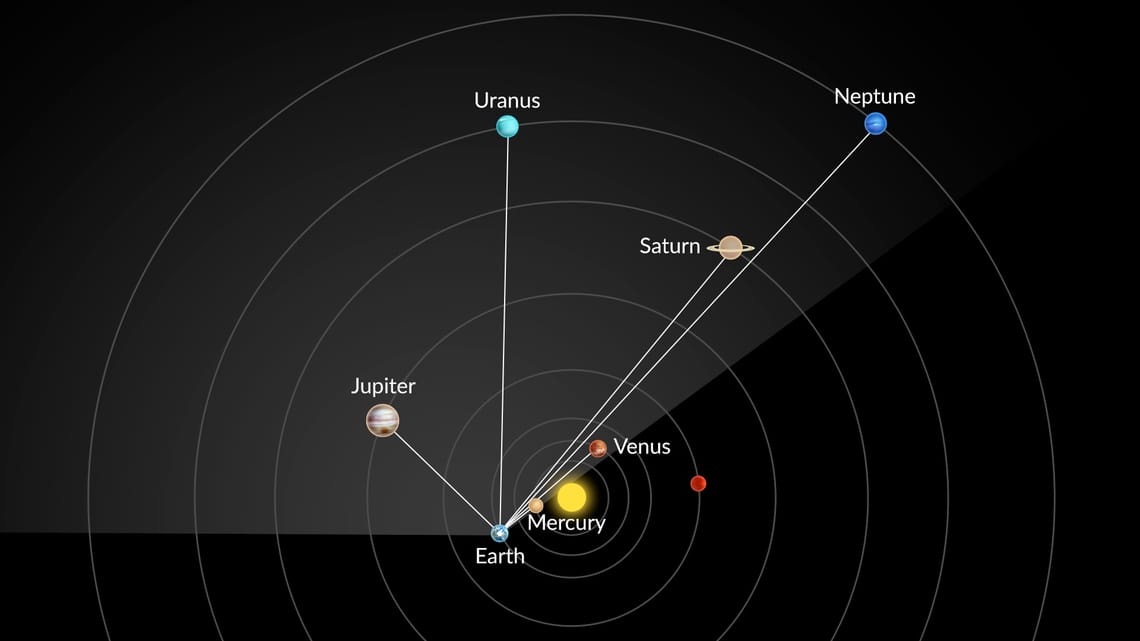
This is how the planetary alignment on February 28 looks from above the Solar System’s plane.
©Vito Technology, Inc.
NASA highlights this date as a “Planetary Parade” — and the main reason it’s special is that several bright planets are visible at once without optical aid.
This parade will include:
- Mercury
- Venus
- Saturn
- Jupiter
- Uranus
- Neptune
Such celestial events are pretty uncommon, especially when four bright planets can be seen at once without any optical aid. What makes this “parade” even more special is its evening visibility, which is more convenient for most observers than early-morning alignments. If you want the general explanation of what counts as a “planet parade” (and other upcoming alignments), read our Planet Parade guide.
When to See Six Planets Align?
This is a late‑February / early‑March event, not a single 5‑minute moment: different places get their “tightest lineup” on slightly different evenings.
- Main date: February 28, 2026
- Best time: during the first hour after local sunset (Mercury is time‑sensitive)
- Visibility window: late February to early March (varies by location)
February 28 is a median date — the moment when the planets appear most tightly grouped for many locations worldwide. Depending on where you live, the best viewing date may fall a few days earlier or later.
Best Dates to See the Planet Parade by Location
Here are example dates when the planets gather in the smallest sector of the sky:
- São Paulo: February 25
- Athens: February 28
- New York: February 28
- Mexico City: February 28
- Tokyo: February 28
- Beijing: March 1
- Berlin: March 1
- London: March 1
- Mumbai: March 1
- Reykjavík: March 2
To choose the best viewing date and time for your location, use the Planet Walk feature in the Star Walk 2 app.
Which Planets Will Be Visible During the Planetary Alignment?
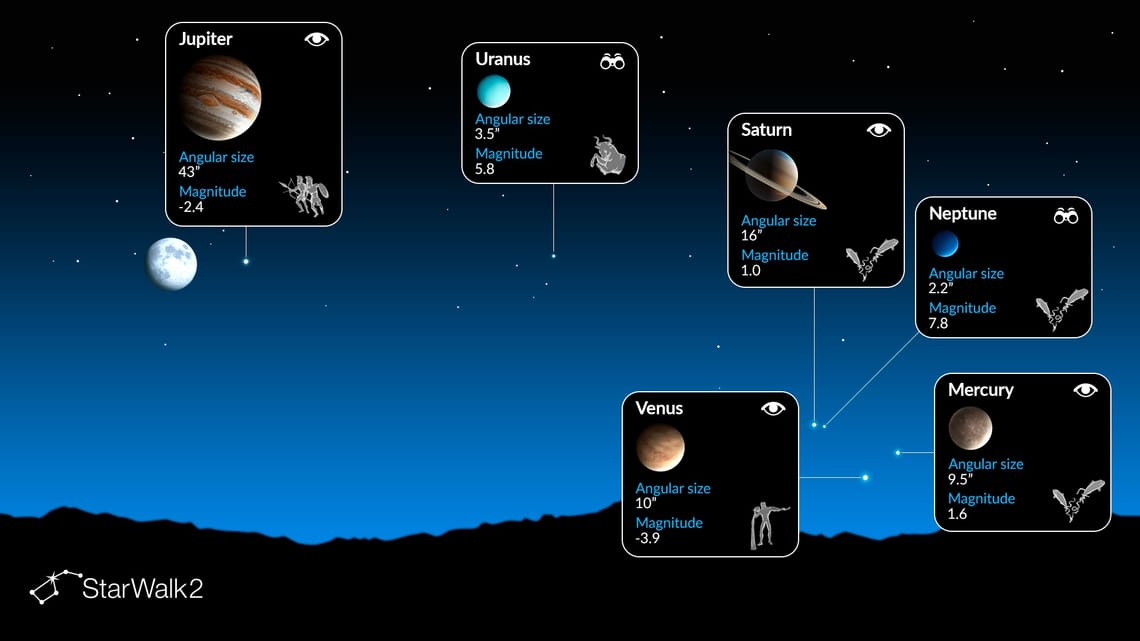
On February 28, six planets — Mercury, Venus, Jupiter, Saturn, Uranus, and Neptune — will appear together in the sky.
©Vito Technology, Inc.
During the planetary alignment on February 28, six planets will be visible in the evening sky, but not all of them will be equally easy to spot. Some shine brightly, while others are fainter and require binoculars or a telescope. Here they are, arranged by visibility from easiest to most challenging to observe.
Naked-eye planets:
- Venus (mag −3.9) — the brightest object in the sky (after the Moon)
- Jupiter (mag −2.4) — also brilliant and unmistakable
- Saturn (mag 1.0) — moderately bright and easy to spot
- Mercury (mag 1.6) — small and subtle
Planets requiring optics:
- Uranus (mag 5.8) — binoculars required
- Neptune (mag 7.8) — powerful binoculars or a telescope required
To help you plan your observation, the table below summarizes where to find each planet (in the Northern Hemisphere) and whether you need binoculars or a telescope to see it.
| Planet | Naked eye? | Where in the sky | How long visible after sunset |
|---|---|---|---|
| Mercury | Yes (challenging) | Very low in the western sky | ~1 hour |
| Venus | Yes | Very low in the western sky | ~1 hour |
| Saturn | Yes | Low in the western sky | ~1.5 hours |
| Jupiter | Yes | High in the eastern to southeastern sky | Most of the night |
| Uranus | No | High in the southwestern to western sky | Until around midnight (with optics) |
| Neptune | No | Low in the western sky | ~1.5 hours (with optics) |
Below, you’ll find a planet-by-planet breakdown explaining where each one appears in the sky and how its visibility changes during the evening.
Mercury: A Brief Evening Appearance
On February 28, 2026, Mercury will be nearing the end of its evening visibility period after reaching its greatest separation from the Sun earlier in the month. It will appear very low above the western horizon, in the constellation Pisces, shortly after sunset.
Because Mercury sets quickly, it will be visible only for a short amount of time — probably less than one hour. Start observing as soon as the sky darkens and make sure you have a clear, unobstructed view of the horizon.
Venus: The Bright Guidepost
Venus will be impossible to miss. Shining at magnitude −3.9 in the constellation Aquarius, it will dominate the western sky and serve as the easiest reference point for locating Mercury and the other planets.
Although Venus is the brightest planet in the alignment, it will also sit very low in the sky, requiring early-evening observation and a clear western horizon.
On the evening of February 27, Venus will pass about 5° from Mercury. On February 28, the two planets will still appear close together. However, their proximity to the Sun and low elevation above the horizon will make them harder to spot.
Saturn: Steady and Golden
Slightly higher above Venus, Saturn will glow with its characteristic soft yellow light in the constellation Pisces. Unlike stars, its light will appear steady and non-twinkling — that’s how you can recognize it. Or you can simply use the Star Walk 2 app!
Saturn’s position makes it an important visual bridge between the low-horizon planets (Mercury and Venus) and the higher parts of the alignment.
Neptune: A Subtle Neighbor of Saturn
Neptune will be located very close to Saturn in the constellation Pisces — about 1° away! Although invisible to the naked eye, it can be detected with binoculars or a small telescope under dark skies.
If you can spot Saturn first, Neptune becomes much easier to locate by scanning the area nearby.
Uranus: Higher in the Sky, But Harder to See
Uranus will appear much higher above the horizon, in the constellation Taurus. While it can technically be seen without optical aid under perfect dark-sky conditions, binoculars are strongly recommended.
Moreover, Uranus will be located not far from the Pleiades star cluster — the distance between them will be about 5°. The Pleiades (which are visible to the naked eye under dark skies) can help you find the faint planet quicker.
Jupiter: The Dazzling Giant in the Southeast
On the opposite side of the sky — high in the southeast — Jupiter will shine brightly. It will be positioned in the constellation Gemini, not far from the bright stars Castor and Pollux.
As a bonus, the 90% illuminated Moon will appear very close to Jupiter — the distance between them will be about 4°. On the downside, the almost full Moon will also brighten the sky, making faint planets like Uranus harder to spot.
With binoculars, try looking just below the Moon for the Beehive Cluster (M44) — one of the brightest open clusters. It’s an easy “extra” target to make the session more rewarding.
How the Alignment Changes During the Night
The planetary alignment on February 28 will be best seen shortly after sunset. Here’s what will happen with the planets as the evening progresses:
- Mercury and Venus will set first
- Saturn and Neptune will follow
- Uranus will remain visible longer
- Jupiter will set last
Because of this, timing is critical — especially if you want to see all six planets in one session. Right below, we’ll show you an easy way to do it.
How to Find All Six Planets Easily
The easiest and fastest way to spot all six planets is by using the Planet Walk feature in the free Star Walk 2 app. Here’s how to use it:
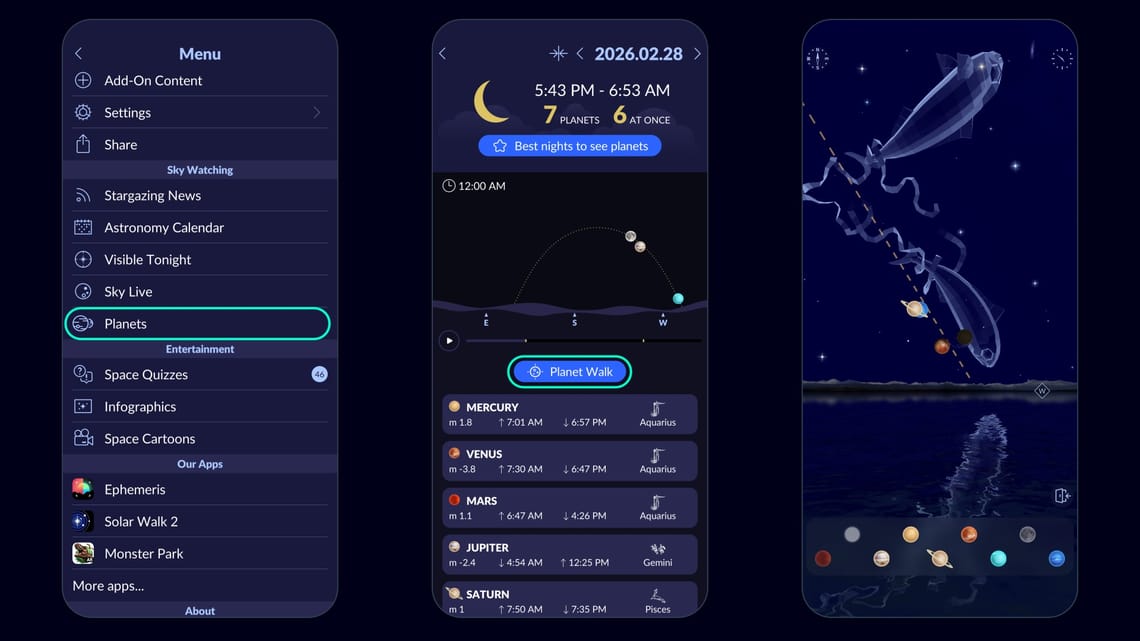
Use the Planet Walk feature in the Star Walk 2 app to quickly find all six planets in the sky during the alignment on February 28, 2026.
©Vito Technology, Inc.
- Open Star Walk 2 and go to Menu > Planets.
- Tap the Planet Walk button or select any planet in the list.
- Point your phone at the sky to match the map with real celestial objects.
- Tap any of the planet icons and follow the arrow to locate the planet in your sky.
- Tap the camera icon to turn on AR mode for an immersive sky-overlay view.
Planet Walk highlights all planets at once — something most stargazing apps can’t do.
Where to Look to See the Planetary Alignment on February 28, 2026?
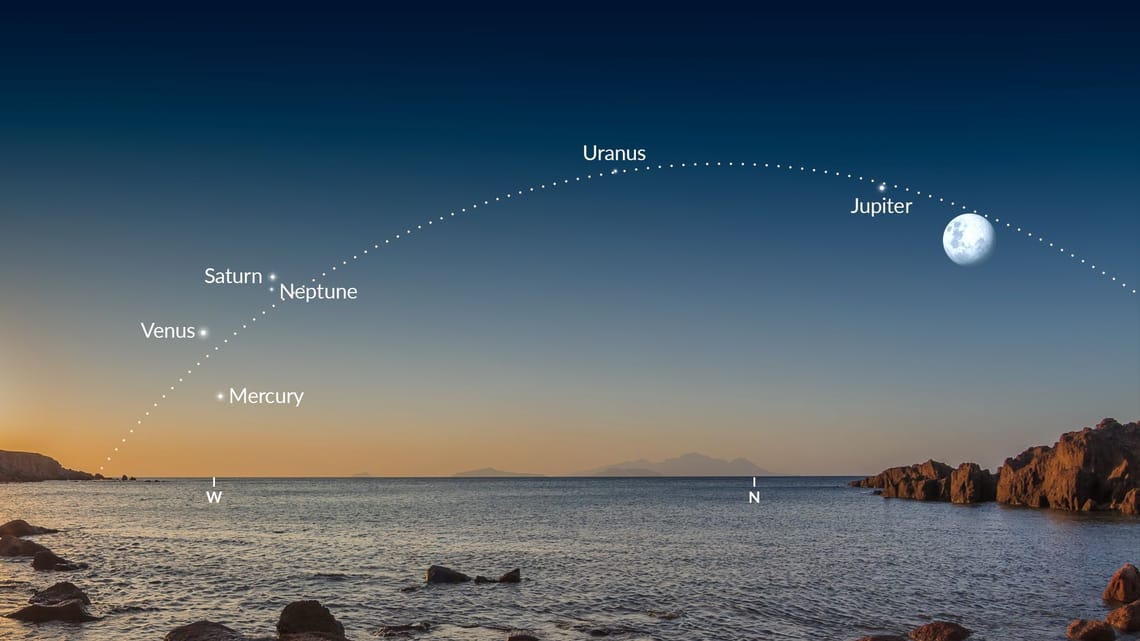
Planetary alignment on February 28 as seen from the Southern Hemisphere.
©Vito Technology, Inc.
On the evening of February 28, the six planets will be spread across the sky from west to east. Here’s where you should look to spot them:
- West / Southwest: Mercury, Venus, Saturn, Neptune
- Southwest (higher in the sky): Uranus
- Southeast: Jupiter, close to the bright Moon
The planets will trace a gentle arc across the sky, following the ecliptic — the path the Sun takes throughout the year.
Note that in the Southern Hemisphere, the overall layout will be similar, but the arc of the alignment will tilt in the opposite direction.
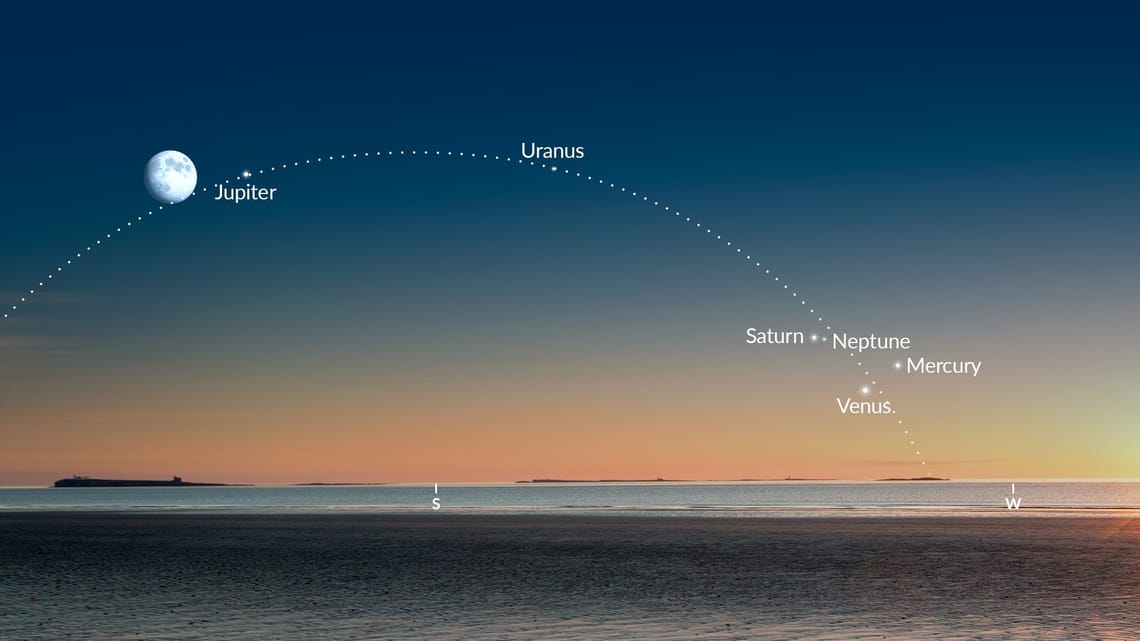
Planetary alignment on February 28 as seen from the Northern Hemisphere.
©Vito Technology, Inc.
Quick Tips for Observing the February 2026 Planet “Parade”
Most missed sightings happen for two reasons: a blocked western horizon (trees/buildings) and low‑altitude haze that hides Mercury and Saturn in twilight. Use this checklist to maximize your chances in one short evening session.
- Start observing as soon as the sky darkens
- Choose a location with a clear western horizon
- Bring powerful binoculars or a telescope if you want to see Uranus and Neptune.
- Safety note: Never point binoculars or a telescope anywhere near the Sun.
- If you use optics near the western horizon, wait until the Sun has fully set and never sweep the sky close to the Sun’s position.
- Don’t wait too long — Mercury sets quickly!
- Remember: planets shine steadily — that’s how you can separate them from twinkling stars.
To be absolutely sure that you’re looking at a planet and not a star, identify celestial objects in real time using the Star Walk 2 app.
FAQ: Planetary alignment on February 28, 2026
What is a planetary alignment?
A planetary alignment (often called a “planet parade”) is when several planets appear grouped along the ecliptic as seen from Earth. For a full explanation (and other upcoming alignments), see our Planet Parade guide.
Why is February 2026 trending?
February 2026 is trending because a rare “planetary parade” happens around February 28, 2026 — six planets appear in the evening sky shortly after sunset. NASA also highlights February 28 as a “Planetary Parade” in its list of notable 2026 sky events.
Which planets will align on February 28, 2026?
Six planets take part in the alignment: Mercury, Venus, Saturn, Jupiter, Uranus, and Neptune. (Visibility depends on your location and local sky conditions.)
Will all six planets be visible to the naked eye?
No. Under good conditions, Mercury, Venus, Saturn, and Jupiter can be seen without optics. Uranus and Neptune are much dimmer and usually require binoculars or a telescope.
What time is the best to see the alignment?
In most locations, the best window begins about 30 minutes after local sunset. The exact timing depends on your latitude and how clear your western horizon is.
What time is the best to see the alignment in the United States?
In the US, start about 30 minutes after your local sunset and look low in the western sky. The Mercury/Venus part of the lineup is brief, so try to observe within the first hour after sunset.
What time is the best to see the alignment in the UK (England)?
In the UK (including England), the tightest grouping is around March 1. Start about 30 minutes after local sunset with a clear western horizon — Mercury can be very low and tricky in bright twilight.
Where should I look in the sky?
Look along the ecliptic (the path the Sun and planets follow). On this date, Mercury/Venus/Saturn will be low near the sunset direction, while Jupiter will be much higher in the sky.
Why is Mercury (and sometimes Saturn) hard to spot?
Mercury stays close to the Sun in the sky, so it sits very low near the horizon and sets soon after sunset. Saturn can also be faint in twilight, especially if there’s haze or light pollution.
Do I need a telescope to see Uranus and Neptune?
A telescope helps, but binoculars can be enough — especially for Uranus. Neptune is fainter and more difficult, so a telescope (and a dark sky) makes it much easier.
Is this alignment rare?
Seeing several planets in the sky on the same evening is not extremely rare, but a lineup of this many planets that’s convenient to observe (especially with multiple naked-eye planets) is special — and it’s worth planning for.
Six-Planet Alignment on February 28, 2026: Bottom Line
The planetary alignment on February 28, 2026, is a must-see event for both beginners and experienced skywatchers. With favorable evening timing, this planet “parade” offers a rare chance to see half a dozen planets at once! Plus, a bright, nearly full Moon near Jupiter will make the view even more striking.
If you’re looking for the definition of a “planet parade” and a year-round overview of other alignments, see our Planet Parade explainer.
Want real-time pointing for your exact location? Download the free Star Walk 2 app and use Planet Walk feature to guide you across the sky from planet to planet.
Clear skies!
Contents
Leave a comment